Do These 5 ADHD Hacks Suck as Much for You as They Do for Me?
"some of the tools that I actually do find useful are remarkably unpleasant, inconvenient, or both. I call them “hacks” because they don’t fix the issue, they just temporarily create a workaround that let’s me adult with a bit less effort than it used to take."

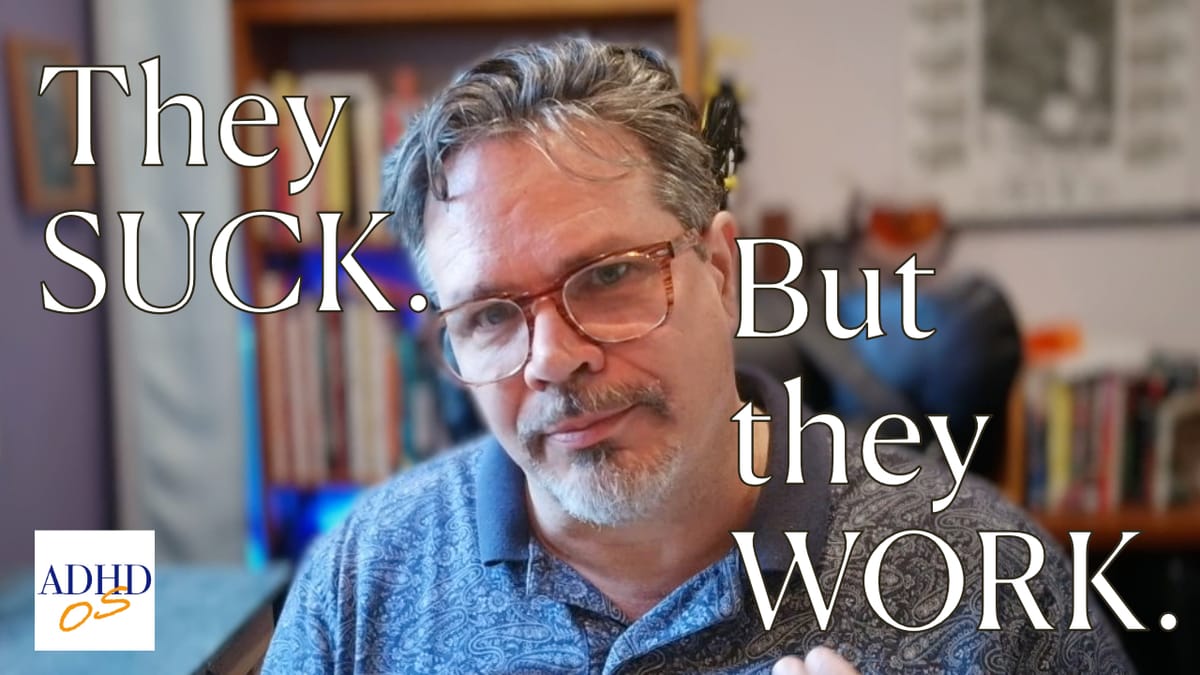
They are unfortunately and annoyingly effective.
“What benefit was there to getting your ADHD diagnosis?”
It’s a question that comes up often with late-diagnosed ADHDers like myself — after all, if I’ve managed for half a century without knowing, what was it really going to change?
The answer is basically that instead of having to experiment and try out a zillion different ways to manage everything in my life — from health to relationships to career to hobbies to adulting in general — I finally had some kind of clue as to how my brain actually works, and why living in a world that wasn’t made for it was so goddamn hard.
Instead of having to try out every tool in the hardware store, I finally had someone show me the “Might Help ADHD” section. Still a whole lot of things to try, but less than the whole store. Just knowing what kinds of strategies to stay away from was a huge relief.
That being said: some of the tools that I actually do find useful are remarkably unpleasant, inconvenient, or both. I call them “hacks” because they don’t fix the issue, they just temporarily create a workaround that let’s me adult with a bit less effort than it used to take.
Let’s be clear here: the “issue” is not my brain. My brain, like the brain of any neurodivergent person, is fine. The issue is the environment where my brain needs to function, including things like time-based productivity, the attention economy, and the %$#@ “buy now” button. But all that will have to wait for another article.
The First Sucky Hack: Cold Showers
I’ve written about these before — using them to perk myself up in the evening when I am having fun and want to push back the time that I turn into a pumpkin.
I still use it for this, but following the example of my brave partner Natasha, I’ve started doing them in the mornings, as well.
They suck. You get used to them sucking, it gets easier to convince yourself to do it, and (I’m told) eventually you swear slightly less as you stand there under the freezing spray. Unfortunately, they also work:
Among those who have tried it consistently, certain patterns keep surfacing. Many report sharper focus in the hours after cold exposure, particularly in the morning. Others say they fall asleep faster and wake up with more energy. Some even use cold water as a pre-task strategy, treating it as a tool to break through inertia and get moving. — Adam Carter, ADHD Certify
If delayed gratification is not your kink, then knowing that future-you will benefit from just-woke-up-you enduring an actual method of physical torture is (if you’ll pardon the expression) cold comfort.
The Second Sucky Hack: Timers, Alarms, and Flow, Oh My!
It’s something of a catch-22: if I’m in flow I can do amazing things. Write, edit, post viral articles. Create entirely new pieces of art. Plan an event. If there’s one advantage to having an ADHD brain in this society, it’s the way hyperfocus can leapfrog the grind and move projects forward.
But one of the key elements of being in hyperfocus (whether ADHD or not) is losing any sense of time passing. “Haha,” my brain says, “I’m way ahead of you, I don’t have any sense of time passing whether I’m in flow state or not!”
After a lifetime of being late, missing appointments, underestimating the time any particular task will take, and even forgetting completely to pick up my daughter from the mall until after it had been closed for two hours*, I have been saved by my Apple Watch.
Now I live by the timer. As I write this, I’m in a one-hour “shut up and write” session, which my phone will interrupt in about forty minutes. This morning my watch, my phone, and my iPad all beeped loudly to make sure I took my meds (both ADHD and other). If I’m sitting at my desk, I need to set a twenty-five minute timer to ensure that I get up and walk around for five minutes (also timed) because while my soul is young my knees are not.
Which may not seem to have a lot to do with ADHD, except that (from what I understand) most brains out there have a sense of time. When they say “be there in five!” they actually mean five minutes. If you ask them to clean the catbox “when they get home” aka later, they will actually remember when they pull in the driveway. And if you say “hey, in a couple of hours you should eat some lunch” they don’t actually need to set an alarm called eat some lunch.
But I do need, so I do set. Over and over and over again — the watch goes on first thing in the morning and comes off last at night. I’m grateful for it — for the ease of just saying out loud “Siri: twenty minutes” and feeling a little haptic pulse on my wrist. It feels comforting.
But it also means that my flow and hyperfocus is consistently interrupted unless I make a point of setting aside uninterrupted blocks of time. It’s a choice I have to make: accept the interruption, or miss out and forget important things.
The Third Sucky Hack: Meds
I’m probably going to get some pushback calling medication a “hack”, but before you flame my comments, please understand why I say this: for me, the medications I take for my ADHD do not actually fix anything — they change my brain temporarily so that I can (mostly) function at the job that keeps me housed and fed.
I’ve had harder jobs than my current position, and even excelled at them — but never for very long, and never without extreme effort. I know this, because when I got my meds in sync I had to consciously reduce the effort I put into it. It’s part of the late-diagnosed grief process to realize wait, this all didn’t have to be this hard all the time?
But it sucks, too. It’s considered a “controlled substance” because it’s compositionally similar to meth, and therefore I have to remember to renew my prescription every month because they’re scared otherwise I’ll get addicted to it.
I’m not gonna second-guess my doctors, but based on the number of times I’ve either forgotten to take my meds in the morning or forgotten to renew my prescription entirely, I think I’m pretty safe.
Last month, because of poor planning on my part, I went for about three days with no meds. I was fine…but I also could feel the way everything that I had learned to do easily at work over the past three years took more effort, more of my energy.
So I’m not addicted — I can quit any time I want! Any time I want to struggle to adult at a job that (mostly) pays my bills. I managed it (again, mostly) for about fifty years before my diagnosis; it wasn’t fun.
The Fourth Sucky Hack: Staying Away From Social Media
The more I learn about the Attention Economy and how there’s a calculated effort to distract, fracture, and extract everyone’s attention via our electronics, the more I feel like we ADHDers are the canaries in the coal mine.
You know the reference, right? Miners would bring canaries down in cages because they were more sensitive to harmful gasses than humans — so if the canary was having trouble living, it gave the humans time to get out before they did too.
We are learning, in study after study, that our divided attention and consistent devotion to serial short-form content is bad for us. We have learned that the companies that create these things, from Facebook to Genshin Impact to Duolingo, all use “dark patterns” to leverage our own behaviors against us, basically creating an environment where people live in a state of intermittent focused rage and fear with buy now buttons ridiculously easy to press.
And if these platforms and apps are bad for the majority of human brains, how much worse is it for a brain that is more easily distracted, primarily motivated by novelty, and more prone to impulsive decisions?
I was an early adopter of almost every social media app as it came out. I had a community of friends on twitter, mainly, but also MySpace (RIP), Facebook, Instagram, and later Threads and Bluesky.
But I found, as the algorithms and interfaces grew better and better at inducing compulsive behavior, that I needed to simply stay away from them.If my partner sent me a Facebook link, I would click with the intent of just reading it and closing the app…but that never happens. There’s always a message to check, or wondering how is my cousin doing? or seeing a little tiny dancer in a box that makes you want to click it for “just one reel.”
Except it’s never actually just one, is it?
I’ve tried app blockers. Timers (see above). Limiting it to certain activities (like walking). None of that keeps me from feeling drained, anxious, and with a sense of lost time after I finally am able to turn it off.
I can’t just get rid of my phone or watch, but I’ve found that just deleting the apps and making sure I’m logged out on my computer make it inconvenient enough to discourage me. Basically I just stay off of them — with the exception of Instagram, which I am using to build my Papermancy and ADHD Open Space communities.
I see other people who, while still suffering from the dark patterns, seem better able to handle it than my brain, and they have fun. It’s easier for them to plan events, or gossip, or just check on each other.
And I miss it. I miss them. But as they saying goes, of all the things I miss, I would miss my brain the most.
The Fifth Sucky Hack: Writing Everything Down
Just as the big solution for time-blindness is using timers, the biggest solution for poor working memory is writing things down.
My brain used this hack long before I knew I had ADHD, because I was usually the first among my peers to carry a DayPlanner or a PalmPilot (with EverNote), use a bullet journal, use a hipster PDA, or any other particular method that promised to make sense of the VUCA** world I found myself in.
Not that my life was especially more VUCA than anyone else’s — but because of the way my brain perceives it and the decisions I make based on those perceptions…well, it feels VUCA as %$#@ and always has.
The best solution for me has been to use paper-based-thinking (literally, “inkin’ & thinkin’”) to identify, process, and plan things. And I do enjoy it! I love finding new notebooks, papers, inks, pens, and sharing them with others. I’m a sucker for list-based systems and commonplace books and the like. Heck, I’ve created a whole website and nascent community around the practice, both for ADHDers and those with brains more suited to the world we live in.
But it would be nice if my brain could hold information longer than…well, longer then the moment it first receives it. If I could ask my partner what she wants from Taco Bell and actually remember it all the way to the drive thru, instead of asking her to text me. If I didn’t have to worry, all the time, about whether I can trust my calendar or notes, because if I didn’t write it down, it’s gone.
Enjoy some cheese with this whine.
Let’s acknowledge a few things here: I’m a cis white male in relatively good physical health with a good public education, so regardless of whatever other challenges I created in my youth, I was already playing on the “easy” setting. Just not as “easy” a setting as those like me who didn’t have undiagnosed ADHD — which ain’t nuthin’. I can acknowledge both my challenges and my privilege at the same time.
It’s also definite that getting the diagnosis three years ago improved my life. I doubt I would have been able to stay in the nonprofit field, for example, and my relationships have been more stable and supportive than I ever imagined.
So this is not so much a complaint as a wistful dream of a world where I don’t have to change my brain chemistry to be a functioning adult. Maybe someday. Maybe somewhere.
Meanwhile…it kinda sucks.
* eventually she forgave me.
- * “VUCA: volatile, uncertain, chaotic, ambiguous.” Coined in the mid-80’s by leadership and military folks to describe the post-Cold-War era.