Is It Really Collecting Hobbies? Or Is It Darker Than That?
I will never forget the sound of his shock: “You did what?” Turns out forming an LLC correctly takes more than a few clicks and dollars. But I didn’t have time to wait and figure that out.
How a philosopher I never read might have skewered my psyche
“Too many hobbies” is almost certainly in the top five Tropes of ADHD. Put simply, we have a tendency to hear about some occupation, craft, skill, or quest, and our minds latch onto it: I want to do that.
It doesn’t really matter if we have ever done anything like it before, or if we are socially, financially, or personally equipped to take it up.
This is nothing new, but like many things (especially ADHD traits) the rise of the interwebs exacerbated and enabled the habit. In the early 2000’s, when I was starting to do freelance work on this wild and crazy World Wide Web, my lawyer suggested during a brief phone call that forming an LLC might be a good idea.
When I hung up the phone, I thought “Huh. Well, better do that first…” and with a few clicks and dollars I’d formed an LLC in the state of Delaware.
I called him back. “Ok, I formed an LLC. Now what?”
I will never forget the sound of his shock: “You did what?” Turns out forming an LLC correctly takes more than a few clicks and dollars.
But I didn’t have time to wait and figure that out. Insert any number of other skill sets into that scenario and you have a pretty good layout of my life.
The thing is, a lot of the time it works. When my lawyer friend helped me fix the LLC, it put food on our table for the next seven or eight years. When I read about the concept of “Open Space Events” in 2007, I decided to try it with a group of friends — and that led to nineteen years traveling throughout North America and occasionally Europe, facilitating and teaching about these “unconferences.”
But, as any of my partners, daughters, or close friends will tell you: a lot of the time it doesn’t. Here’s an incomplete and unordered list of skills that I’ve spent time, energy, and attention on, not to mention dollars and physical space, that seemed to be flashes in the pan:
- Analog photography
- Screen printing
- 3d printing
- Calligraphy
- Graphic Recording
- Vlogging
- Online Open Spaces
- An inflatable hot tub
- Cottage-core crafting
- CNC Router activation
- Maker Space board member
- Board Member of the National Coalition of Sexual Freedom
- Illustrator
- Life drawing event host
- Dance teacher
- gonna stop now, because it starts to get depressing.
The prevailing wisdom in ADHD space is: don’t feel bad about these hobbies!
And I’m not saying anyone should. The coaches, authors, and pundits are right when they point out that these are things that shaped who I have become, and many of the skills, while unable to sustain the weight of “making a living”, enrich the ways I do make a living. Me spontaneously graphic recording a presentation by a nonprofit group when the AV went out. Hand-lettering ambigrams for my grandchildren. Those are things that are part of me, and make my life (and, occasionally, the lives of those around me) better.
One of the useful reframings is to think of these past hobbies not as “given up” or “failed” but rather “shelved.” It’s like a favorite bookshelf or a wine cellar; you don’t worry about whether you have touched the things there lately, they will be there when they need them.
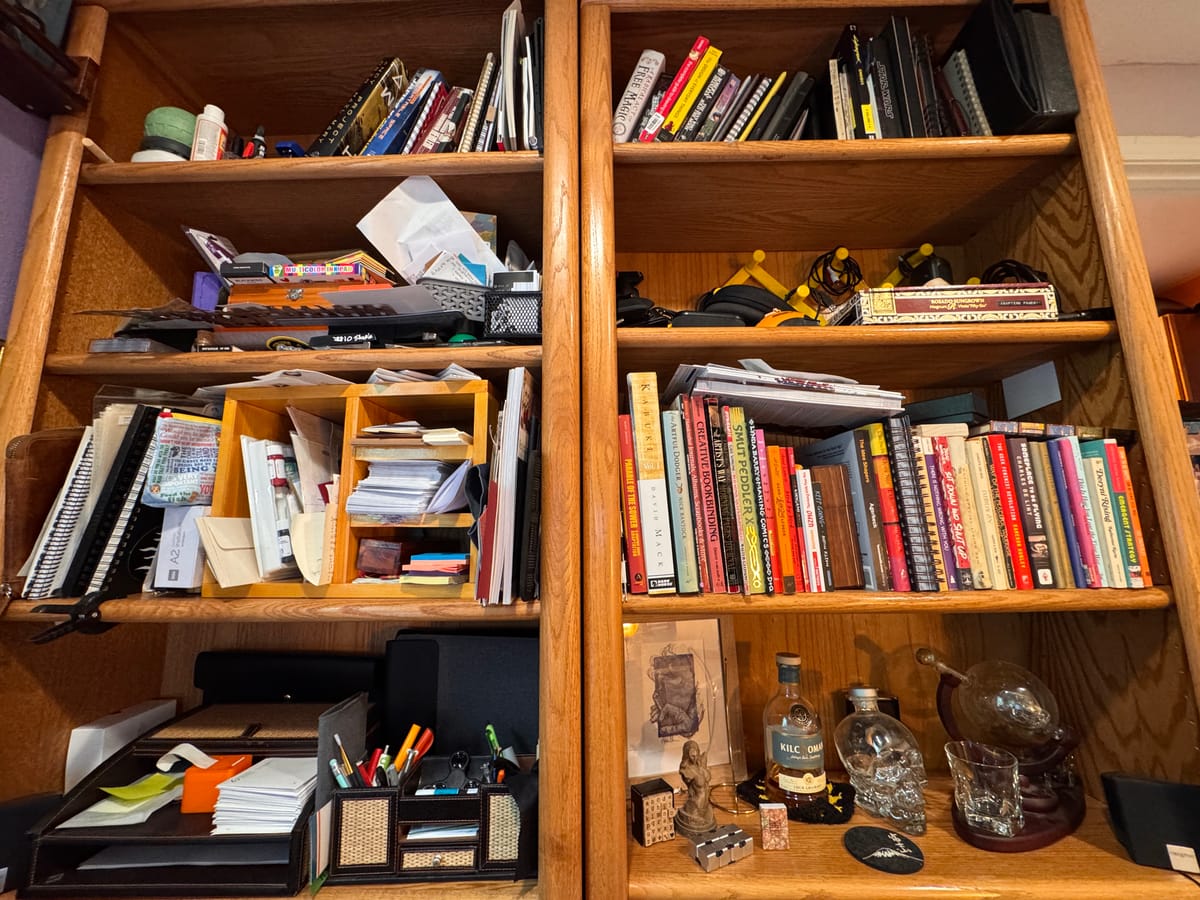
It’s helpful for someone like me who went from the 20th-century myth of “career” (singular) to the 21st century hustle-culture where if it’s not monetizable, it’s not worth doing. While it doesn’t do much for my garage and basement space, it makes seeing the photo enlarger or the bookbinding frame or the stack of game prototypes less like abandoned children and more like old friends waiting for when our paths cross again.
Then Hazel Thayer had to go and ruin it all with her Baudrillard.
I can’t find much information about Hazel online, but as I enjoy a bit of philosophy once in a while she is a regular on my YouTube feed. She talks about nerdy economics of Star Trek, she talks about getting out of the DoomScroll habit, and she’s Canadian, so obviously I’m in her target demographic.
She’s acknowledged her own neurospiciness, so it wasn’t a surprise that she would make a video about having too many hobbies and spending too much money on equipment that briefly (or even never) gets used.
But she didn’t go the usual route of It’s ok, don’t feel bad. No, instead she dug into that well-educated mind of hers to throw some Baudrillard:
“…Baudrillard argues that, in a consumerist society, rather than pursuing happiness directly we pursue signs of happiness…These[pickle ball paddles] do not make me happy, but…when I bought them, I was buying the idea of playing outside with my friends.” — Hazel Thayer, YouTube
I watched that, and it was what I like to call a “dolly zoom” moment:

What if, I thought, I wasn’t taking up these hobbies and things because I found them interesting, or even worthwhile? What if instead I was buying an idea?
And worse, I realized, it hadn’t been an idea of “happiness” as Baudrillard/Thayer had mentioned.
It was an idea of identity. I was taking these things up not because I liked the idea of doing them — but rather, because I liked the idea of a version of myself that did them.
And even more horrifying — thanks to a really good ADHD therapist I work with — I could recognize that it was less about wanting to bethose versions of myself as it was feeling like those versions of myself would be more effective coping mechanisms for the isolationistic and catastrophizing tendencies of my brain.
In other words, I wasn’t actually collecting hobbies, or ideas of happiness.
I was collecting masks.
The question is: why?
That’s the thing that’s been turning around and around in my mind. I know that some read this and think “Well, it’s simple, you just wanted something.”
This triggers the Ableism Alert: any response you give to someone having difficulty that includes the word “just” is ableist (please note: something you do is not necessarily something you are unless you deliberately do it repeatedly).
In this case, the idea of “just pick the hobbies you really want to do” ignores the reality of unconsciously masking for most of your life (in my case, almost fifty years before). It turns out to be very difficult to know which behaviors are
- Things you’ve done to meet expectations of those around you (from family all the way up to the culture you live in)
- Things you’ve done because you’ve been told they would make you happy/successful/good
- Things you’ve done because at least they aren’t the thing you’re currently doing which you just can’t stand any more (I believe this is the reality behind the many career changes typical to ADHD).
- And finally, things that you do because you actually want to do them.
That last one is a real kicker. When do we really have the time to think about what it is we really want? When do we get to do that without the echoes of the many, many voices saying “That’s not realistic” or other forms of discouragement masked as care from people you respect or love or feel an obligation to?
I don’t have an answer, at least at this point. I’m playing with some ideas and talking to people smarter than me to see if there’s even anything to it.
But I think it is a useful strategy to look at anything you “want” and ask not only “would this really make me happy?” but also “would I really like the person I would be if I did this?”
Let me know what you think. We’re all in this together.